

Motility-induced phase separations in confined active particle systems
06.09.2026

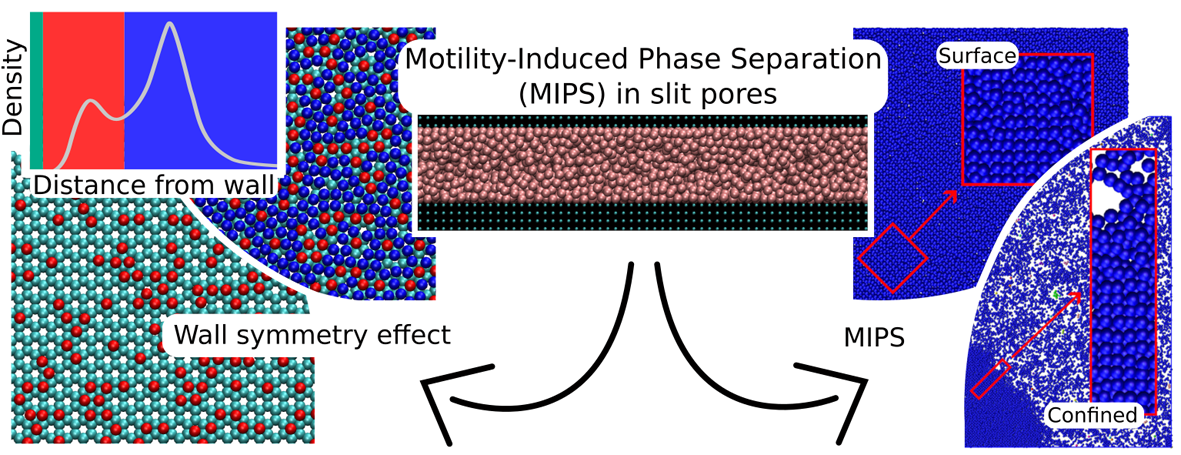 Active Brownian particles (ABPs) serve as a versatile model for synthetic active matter, such as self-propelled colloids, combining persistent propulsion with Brownian motion. When confined, ABPs exhibit propulsion-induced wall accumulation, a phenomenon that can be exploited in microfluidics and lab-on-a-chip applications. In addition, at high confined densities and particle activities, ABPs display distinct structural phenomena, including confined and surface motility-induced phase separations (MIPSs). Confined MIPS manifests as the coexistence of solid-like and dense phases, whereas surface MIPS involves the emergence of high-density clustering structures near the confining walls. The formation of these solid-like and high-density clustering-structure states, along with their structures, is further influenced by wall roughness. We investigate ABPs in slit pores using overdamped Langevin dynamics simulations at a liquid particle density and a particle activity exceeding the bulk MIPS threshold. We examine their wall accumulation and MIPS behavior as functions of slit width and wall roughness. Furthermore, we contrast these confined ABPs with their equilibrium counterparts, confined fluid particles capable of completely wetting the slit walls.
- K. Šindelka, K. Aim, M. Lísal: Motility-induced phase separations in confined active particle systems. Fluid Ph. Equilib. 605, 114690, 2026. DOI


