

Capillary Condensation between Parallel Walls of Unequal Length
06.09.2026

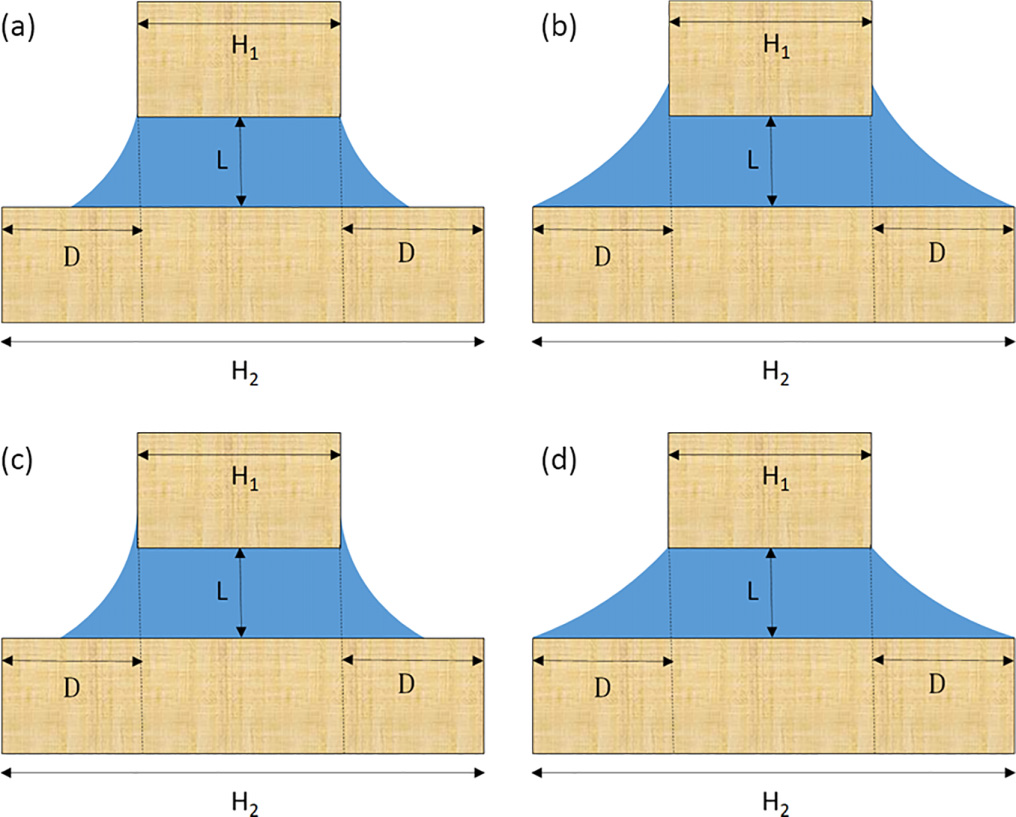 This work develops a macroscopic theory of capillary condensation in asymmetric slit geometries formed by two parallel walls of unequal lengths. Unlike the classical infinite slit, where condensation is described by a single Kelvin equation, finite and truncated walls give rise to multiple competing condensation morphologies controlled by wall geometry and wettability. Using geometric arguments and free-energy minimization based on the concept of edge contact angles, four distinct condensation states are identified: the 1+ state, where menisci are pinned at the edges of the shorter wall; the 1− state, pinned at the longer wall; the 2 state, where both walls pin the menisci; and the 0 state, where the menisci meet the walls at equilibrium contact angles without edge pinning. For each morphology, Kelvin-like equations are derived that determine the undersaturation at which condensation occurs. The resulting phase behavior is governed by three dimensionless parameters: the reduced upper-wall length H1/L, the relative overhang D/L, and the Young contact angle θ. The analysis reveals two fundamental organizing principles: a geometric separatrix at D = L that distinguishes 0‑condensation from 2‑condensation, and the wedge-filling threshold θ = π/4, which separates a rich four-state regime from a simpler two-state regime. Global phase diagrams show how increasing contact angle progressively suppresses the 0 and 1− condensation states, enlarges the no-condensation region, and eventually leaves only the 1+ and 2 states for θ > π/4. Analytical asymptotic expressions are obtained for all phase boundaries and condensation limits, including saturation conditions and scaling laws near geometric transitions. The theory demonstrates how finite-size effects and asymmetric confinement qualitatively modify capillary phase behavior relative to classical slit models.
- A. Malijevský: Capillary Condensation between Parallel Walls of Unequal Length. Phys. Rev. E 112, 065502, 2025. DOI


