The electrodiffusional theory for the wall shear stress measurement by two-strip probe
The wall shear stress vector is the key quantity influencing the transfer phenomena in the boundary layers. Instead of conventional measurement techniques, which often fail in the vicinity of solid surfaces, the electrodiffusion method seems to be a suitable candidate for the measurement of boundary layer hydrodynamics. However, in order to exploit its full potential, knowledge of the theory linking the measured limiting electric current to the shear velocity vector at the wall is required. The newly derived electrodiffusion theory provides a means for experimental measurements to obtain the wall shear stress vector. The measurements are performed with a two-strip probe, which, in a compact design, provides the two electrical signals necessary for a complete description of the wall shear stress vector. In addition to the development of a suitable methodology for the evaluation of the experimentally obtained data, the publication also deals with the theoretical analysis of the mass transfer in the vicinity of the measuring probe, and the optimal aspect ratios of the sub-segments are proposed in order to maximize the sensitivity of the probe to changes in the angle of the flowing fluid.
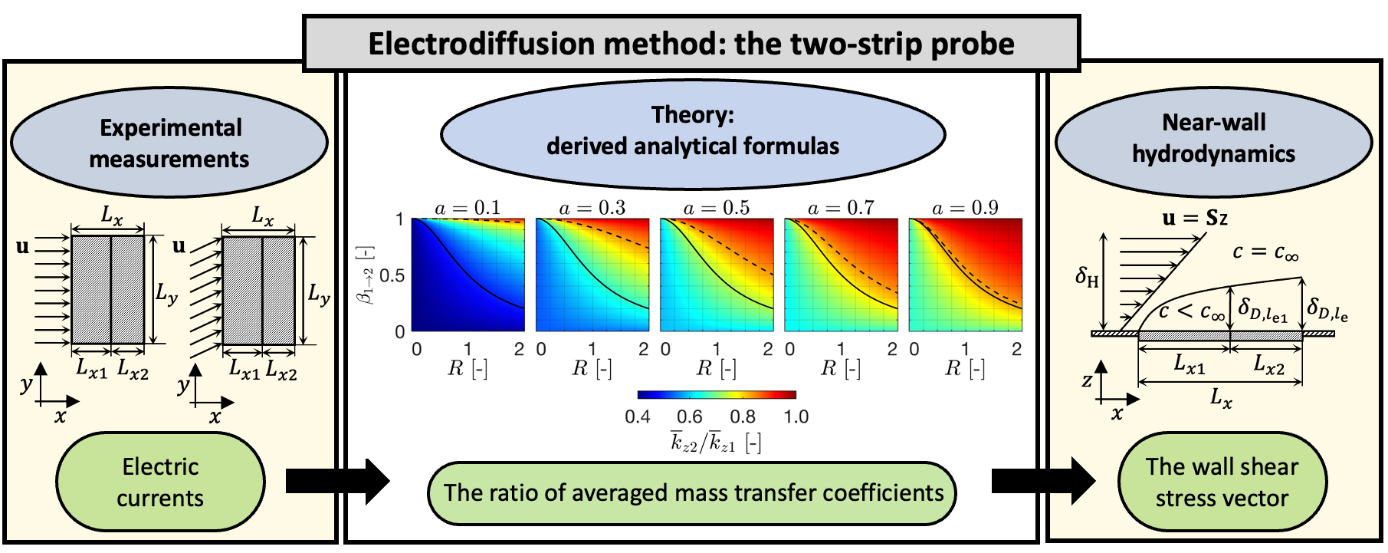
Fig. Application of the electrodiffusional method for the wall shear stress measurement by two-strip probe
Harrandt, V., Kramoliš, D., Huchet, F., Tihon, J., Havlica, J., The electrodiffusional theory for the wall shear stress measurement by two-strip probe. International Journal of Heat and Mass Transfer. 212, 124287, 2023. DOI: 10.1016/j.ijheatmasstransfer.2023.124287