The removal of carbon dioxide (CO2) and sulphur dioxide (SO2) from industrial flue gases is a key challenge in environmental protection and in the development of modern separation technologies. The effective capture of these gases is closely linked to the design of innovative materials and to a detailed understanding of their sorption properties for all flue gases. This issue is addressed by the Research Group of Membrane Separations.
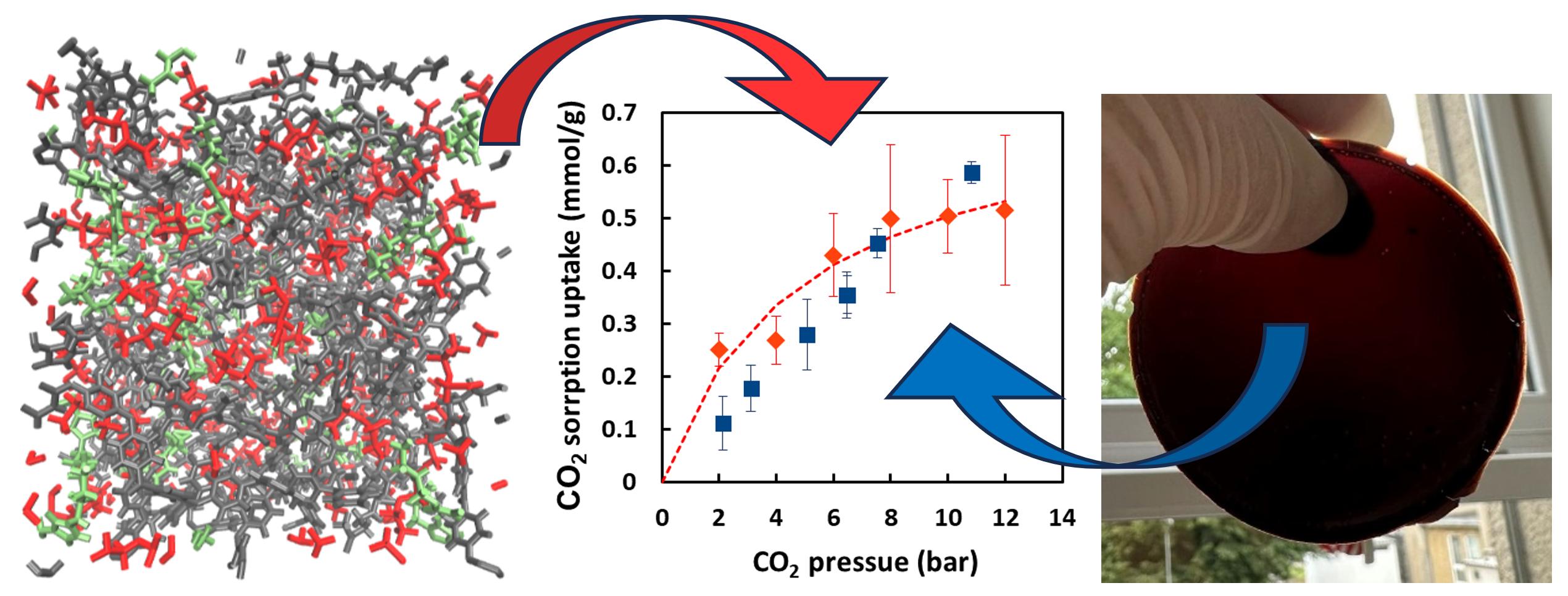
In this work, an advanced experimental sorption method was combined with molecular modeling using Grand Canonical Monte Carlo (GCMC) and Molecular Dynamics (MD) simulations to better understand the mechanisms of gas sorption in advanced composite membranes based on highly chemically durable poly(ether-ether-ketone) (PEEK) ionenes. The sorption properties of acidic gases (CO2, SO2) and non-reactive gases (CH4, N2), as well as SO2 + N2 mixtures in membranes containing PEEK segments interconnected by imidazolium groups and blended with complementary imidazolium ionic liquids (ILs) were studied.
The results showed that SO2 shows the highest sorption activity, even in strongly dilute mixtures (~5000 ppm) with nitrogen. The sorption order was determined as SO2 > CO2 > CH4 > N2. It was also found that the PEEK-ionene variant without methyl substitution on the imidazolium core exhibits a higher selectivity of CO2/N2 solubility than the methylated variant. However, this difference decreases with increasing pressure, likely due to reduced polymer chain mobility and the dominating influence of the “free” ionic liquid on gas transport. Furthermore, molecular simulations revealed that the presence of 2 equivalents of ionic liquid in the composite maximizes polymer chain elongation, whereas higher ionic liquid content contracts the polymer chains and increases polymer density, thereby decreasing the available free volume for permeating gas molecules.
This study demonstrates the importance of interlinking experimental and computational methods to design new membrane materials with high potential for the efficient cleaning of industrial flue gases.
- Stanovský P., Škvára J., Vopička O., Friess K., Ravula S., Bara J.E., Kujawski W., Wang D.K., Izák P.: Gas sorption and permeation in novel PEEK-ionene membranes: Structural, pressure effects and modeling. Sep. Purif. Technol. 2026, 389(May 9), 136895. doi.org/10.1016/j.seppur.2026.136895