A Modular Synthetic Strategy toward Fast-Growing Poly(amide-carbosilane) Dendrimers Based on Click Chemistry and Organic Solvent Nanofiltration
How can chemistry imitate biological systems? Nature widely uses biopolymers as both construction and functional materials, producing precisely defined nanostructures. Synthetic chemists strive to achieve a similar degree of organization by using sequential synthesis, but with increasing molecular size, it is ever more difficult to keep control over the molecular structure. Our team has been working on the synthesis of dendritic (regular, highly branched polymeric) molecules for more than two decades. Recently, we made a step forward from the well-known carbosilane structures, whose modification potential was limited, and developed a structurally new type of poly(amide-carbosilane) (PAMCAS) dendrimers.
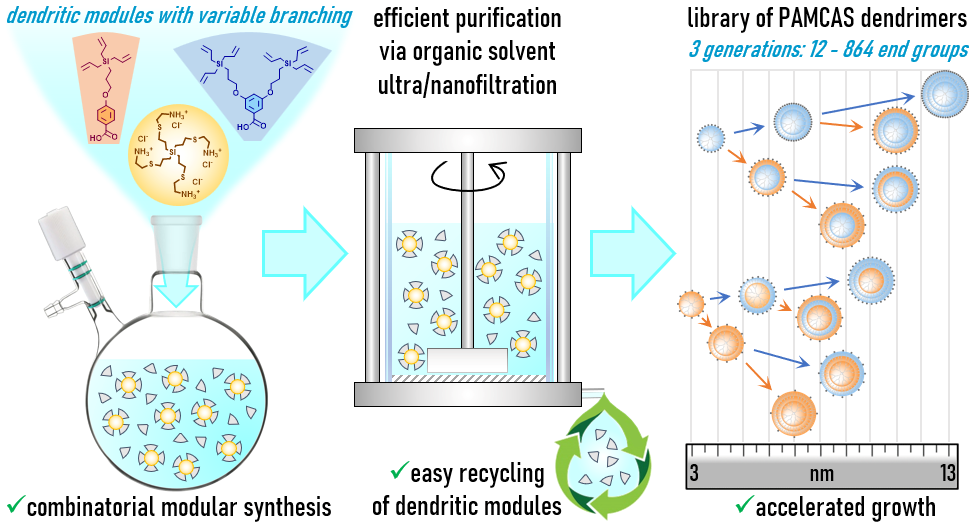
In the paper in the prestigious ACS Polymers Au journal, we introduce this novel modular synthetic strategy leading to PAMCAS dendrimers. In contrast to most reported methods for dendrimer synthesis, it offers accelerated molecular growth, scalability, and efficient purification. All reactions are high-yielding, reproducible, and easy to perform, leading to products with very low dispersity. Using three building blocks (a core and two branched monomers), we synthesized a series of horizontally stratified homologues (dendrimers of the same generation differing in the branching degree in particular layers) up to the third generation. In just six synthetic steps, we were able to obtain a dendrimer bearing 864 functional peripheral groups with a size comparable to large proteins, such as immunoglobulins (antibodies). As the modular synthetic strategy poses a considerable purification challenge, we implemented organic solvent nanofiltration as a main separation tool, which provided high-purity materials in excellent yields, and simplified the recycling of excess dendritic building blocks, thereby contributing to the economy of the method. The size and solution behavior of all 14 prepared water-soluble polyammonium PAMCAS dendrimers were studied by MADLS, Zeta-PALS, A4F, diffusion NMR, and molecular modeling. Currently, we investigate the size limitations of the reported protocol in order to obtain colloidally stable, low-dispersity macromolecules with MW over 106 Da and with sizes approaching virion particles.
The study was carried out in the Research Group of Bioorganic Chemistry and Biomaterials with the aid of the Analytical Department of the Institute of Macromolecular Chemistry, the Department of Physics of J. E. Purkyně University in Ústí nad Labem, and the Department of Low Temperature Physics at Charles University. The chemical and physical properties of PAMCAS dendrimers, together with their easy tunability and possibility of subsequent peripheral functionalization, make them good candidates for many nanotechnology applications, such as nanotherapeutic formulations, innovative functional materials, or models to study interactions and effects of multivalency.
- Edr A., Konhefr M., Krupková A., Červenková Šťastná L., Bernášková J., Kočková O., Vlčková V., Walterová Z., Kanizsová L., Lang J., Žváček J., Malý M., Strašák T.: ACS Polym. Au 2026, 6(1), 454–467. doi.org/10.1021/acspolymersau.5c00171