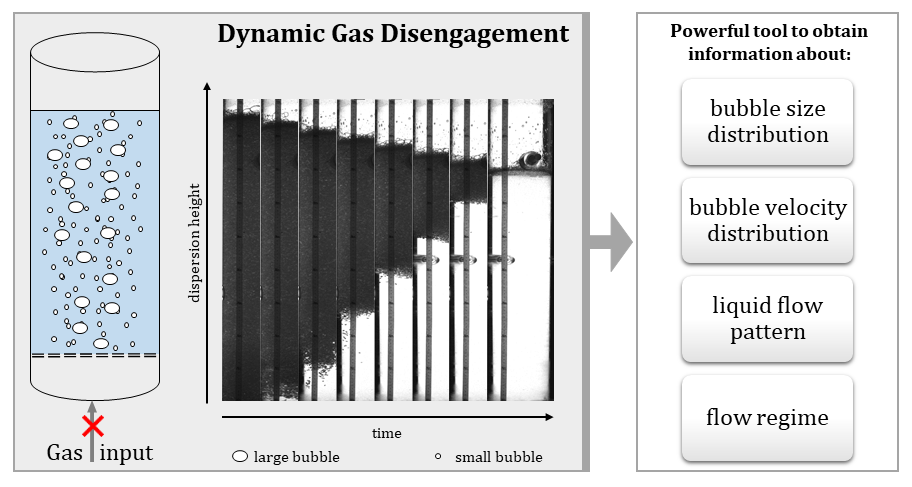
Dynamic Gas Disengagement (DGD) is a powerful tool, method or technique, for studying the multiphase hydrodynamics of gas-liquid and gas-liquid-solid systems. These systems are important subjects in reactor engineering and a variety of industrial applications. This review article provides the most comprehensive analysis of the DGD technique in the context of bubble column reactors within the last 50 years, from its origin to nowadays. It explains the basic physical mechanisms of the DGD process, which is a highly unsteady collapse of dispersed layers. The article provides an overview of the original ideas from which this method stems, its historical evolution, its development, experimental and modelling aspects, and applications across different flow systems. The study emphasizes the DGD ability to provide detailed insights into the internal structure of the bubble bed in the dynamic mode. For example, it reveals information about. the bubble velocity classes, the corresponding bubble size classes, interfacial areas and flow regimes. These insights enable the estimation of transport and reaction quantities in multiphase reactors.
This review article discusses the potential DGD applications, ranging from the laboratory-scale validation of computational fluid dynamics (CFD) and population balance models to the pilot-scale, AI-assisted monitoring of processes, and, ultimately, real-time, non-invasive control of industrial reactor processes.
DGD principles can also be used to enhance our understanding of natural processes, such as bubble plumes and underwater gas leaks, which are important to the global carbon cycle. This connection between technology and environmental awareness is significant.
The Research Group of Multiphase Reactors conducted this review, providing a definitive guide to the principles, applications, and future perspectives of DGD in scientific and industrial contexts.
- Růžička M., Orvalho S.*: Dynamic gas disengagement in bubble columns – Review. Chem. Eng. J. 2025, 525(1 Dec), 169497. doi.org/10.1016/j.cej.2025.169497