How to remove pharmaceuticals from water? The HARMONIA model reveals the key role of pH in their removal
The pollution of aquatic environments by pharmaceuticals and other micropollutants represents a growing ecological problem that conventional wastewater treatment plants often cannot adequately address. A promising, low-cost, and sustainable alternative for tertiary polishing is adsorption using biochar. Although this carbonaceous material is highly effective, previous modeling of its adsorption kinetics has relied primarily on simplified empirical models (e.g., pseudo-first- or pseudo-second-order). However, these lack a physical basis and cannot reliably predict system behavior under real, transient conditions. A research team from our institute (Martina Dlasková, Pavel Dytrych, and colleagues) has therefore introduced an innovative mechanistic model, HARMONIA, in a new study that overcomes these limitations. The new mathematical framework directly links the adsorption rate to the biochar’s surface chemistry, which is strongly pH-dependent, and to the speciation of the pollutants.
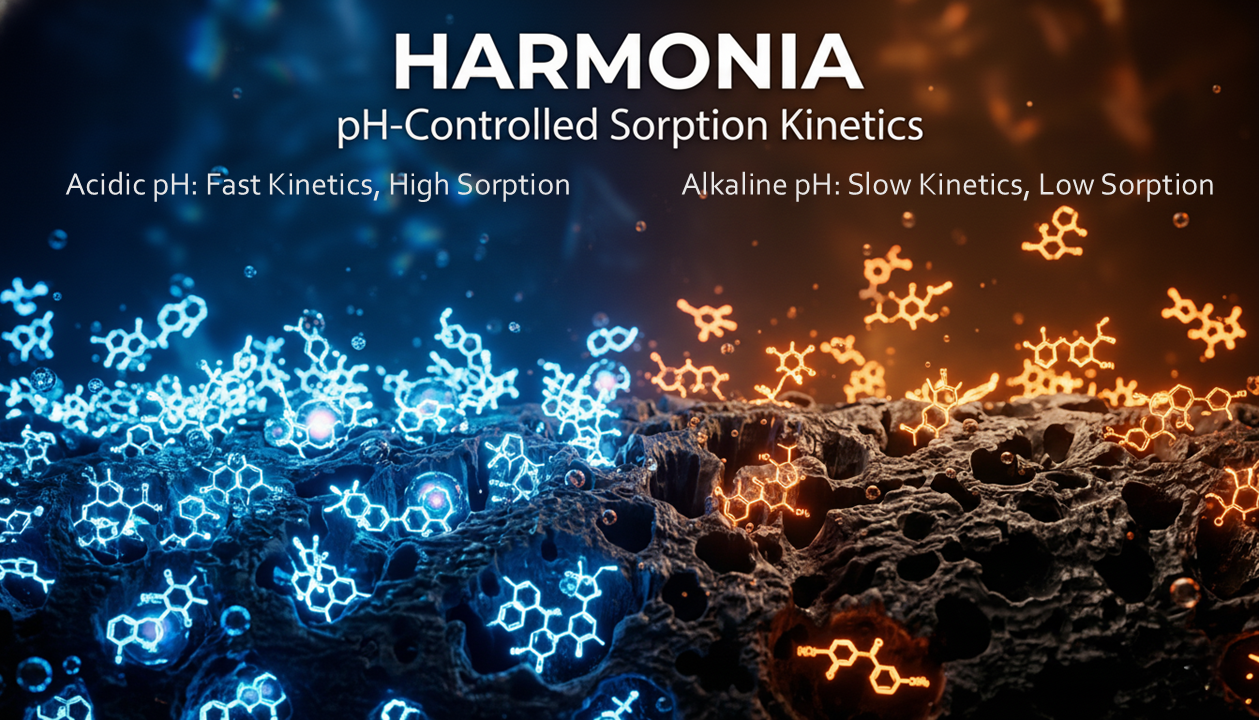
To ensure the model is anchored in real physicochemical parameters rather than mere mathematical curve-fitting, the scientists utilized advanced instrumental techniques. Using Raman spectroscopy and FTIR, they accurately quantified the proportions of aromatic and oxygenated functional groups on the material’s surface. The results of experiments with four common pharmaceuticals (acetaminophen, diclofenac, tramadol, and sulfamethoxazole) revealed the crucial role of pH in their uptake mechanisms. While very rapid electrostatic attraction dominates in acidic environments, strong electrostatic repulsion occurs in alkaline regimes. In such cases, adsorption proceeds via a much slower, diffusion-limited pathway through the hydrophobic aromatic structures of the biochar. The HARMONIA framework can accurately describe this kinetic bifurcation and statistically outperforms traditional models that fail under these complex conditions. Furthermore, the model successfully predicts the competitive removal of substances in multi-solute mixtures without the need for re-parameterization. This work thus provides a highly transferable engineering tool for optimizing contact times in real-world wastewater treatment technologies, where pH and effluent composition frequently fluctuate.
- Dlasková M., Dytrych P., Fajgar R., Spáčilová M., Jandová V., Šolcová O.: pH-mediated adsorption of pharmaceuticals by biochar: Correlation between experiment and theory. Results Eng. 2026, 109930. doi.org/10.1016/j.rineng.2026.109930