Photocatalytic degradation of pharmaceuticals by visible light using thin films of graphitic carbon nitride
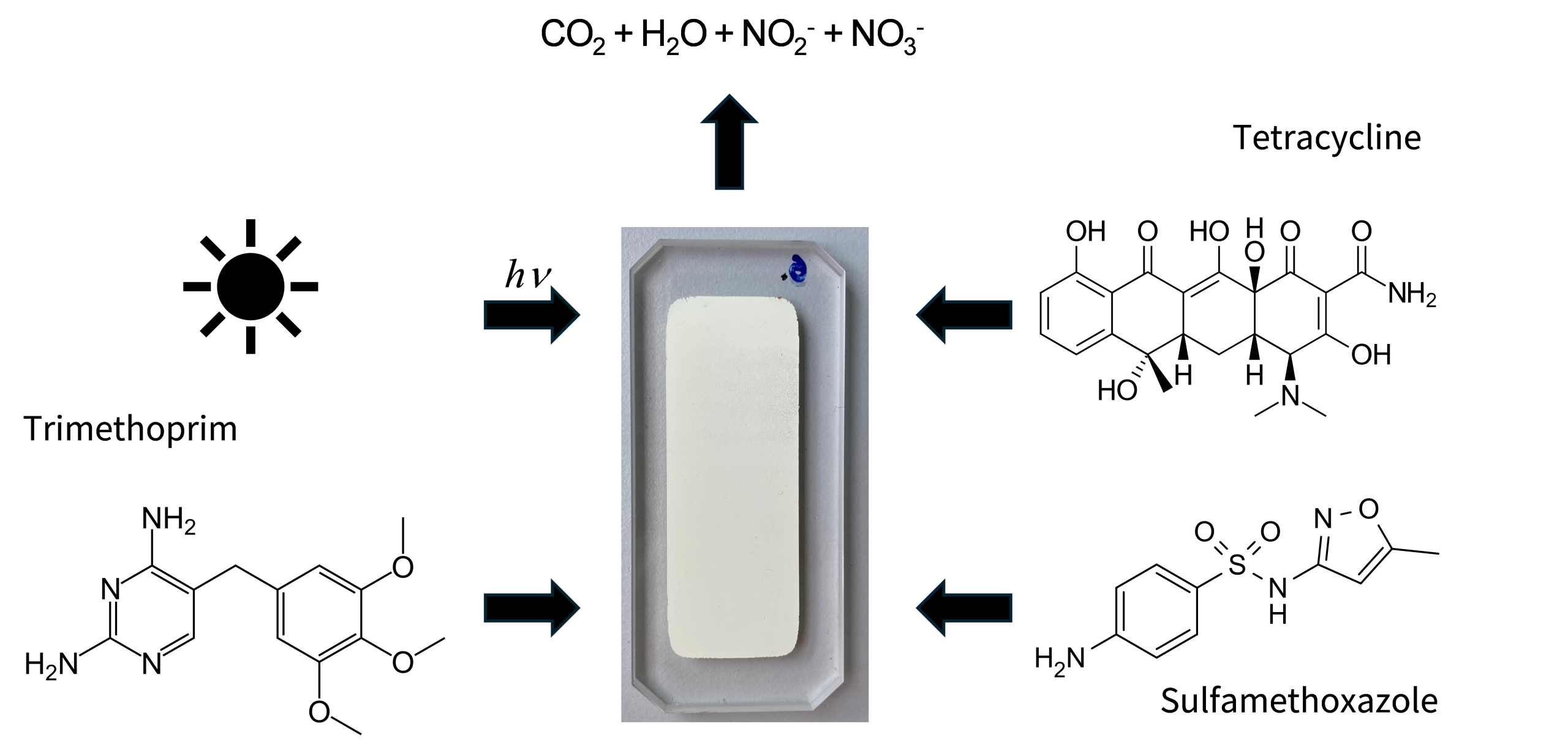 The release of pharmaceuticals and their metabolites into the environment poses pollution risks with consequences in fauna and flora that are not yet fully known nor understood. Photocatalytic degradation of these substances by graphitic carbon nitride (g-C3N4) using visible light could potentially contribute to reducing these risks. In this work, g-C3N4 was investigated in two different forms for the degradation of three selected antibiotics: tetracycline, trimethoprim, and sulfamethoxazole. Emphasis was placed on investigating the description of degradation pathways, modeling the mechanism, and comparing the two photoreactor systems. g-C3N4 in powder form was studied in a batch photoreactor, while g-C3N4 in the form of photocatalytic film was studied in a photomicroreactor with a slit geometry. It was found that during the photo-oxidation processes, the oxidation products of the starting material predominate in the reaction mixture, while degradation products of smaller molecular weight are directly mineralized. Comparison of the batch photoreactor and the microreactor with the developed photocatalytic film showed that the photomicroreactor was able to use the incident radiation more efficiently to degrade the investigated substances. This study was carried out in the framework of cooperation between the Research Group of Microreactors at the ICPF and the Faculty of Chemistry at Brno University of Technology and the Faculty of Science at Masaryk University in Brno.
- Schimon D., Smítková K., Stavárek P.*, Jaklová N., Vanluchene A., Dzik P., Homola T., Zažímal F., Klusoň P.: A complex study of photocatalytic oxidation pathways of antibiotics with graphitic carbon nitride–The way towards continuous flow conditions. J. Environ. Chem. Eng. 2024, 12(6), 114801. DOI