The Research Group of Algal and Microbial Biotechnology has long been exploring the potential uses of microalgae in the food industry. Research led by Dr. Irena Brányiková in collaboration with the University of Chemistry and Technology, Prague, recently published in the prestigious biotechnology journal Journal of Applied Phycology, is focused on fresh spirulina biomass. Some small producers occasionally offer this product seasonally as an alternative to the commonly available dried spirulina.
While dried spirulina is widely known as a “superfood” rich in antioxidants, vitamins, and proteins, its unpleasant taste and the need for energy-intensive drying pose certain limitations. Fresh spirulina retains more valuable nutrients while offering a milder taste and better sensory properties, which consumers evaluate more favorably.
The study thoroughly analyzed the microbiological aspects of using fresh spirulina for food, its safety, and storage conditions. It also included a sensory evaluation of fresh and dried spirulina conducted at the Metrology and Testing Laboratory of the University of Chemistry and Technology, accredited for sensory evaluation of food, with the participation of 33 panelists. It was confirmed that no pathogenic microorganisms were detected in fresh spirulina biomass and that the total number of bacteria remained at an acceptable level during the first 14 days of storage in a refrigerator. In contrast, when stored at room temperature (25 °C), there was a significant increase in microbial contaminants. An interesting finding was that washing the biomass with drinking water after harvesting shortened its shelf life at both tested temperatures.
Further analyses showed that during the drying of spirulina biomass, nutritionally important antioxidants, for which it is primarily consumed, are degraded. Fresh spirulina had up to 60% higher phycocyanin content, 50% more carotenoids, and 87% more vitamin E than dried spirulina. This makes it an attractive food ingredient that combines nutritional benefits with better taste and texture. The results of this study thus provide important information for producers and consumers of fresh spirulina: they confirm its nutritional and sensory advantages, but also emphasize the need for a cold chain and consumption within 10 days of production.
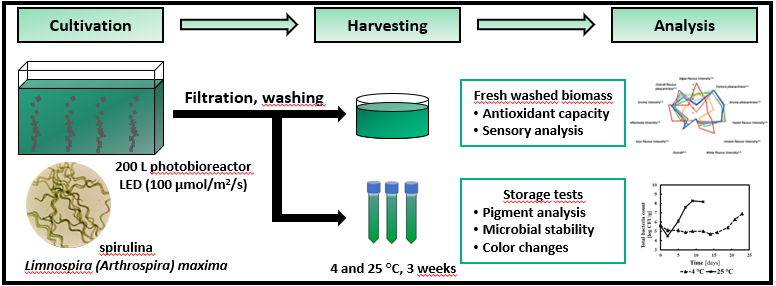
- Vasquez Guevara, C.M., Lucáková S., Branyšová T., Ilko V., Tobolka A. Rajchl A., Brányiková I.: Fresh spirulina biomass for human nutrition – safety, microbiology, storage, sensorics. J. Appl. Phycol. 2025. doi.org/10.1007/s10811-025-03631-9.