Vertical distribution of black carbon and aerosol particles in the atmosphere using drone measurements
Black carbon, as a component of atmospheric aerosol, affects both climate and human health. Its radiative effects, interactions with clouds, and influence on the development of the atmospheric boundary layer strongly depend on its vertical distribution. Without knowledge of vertical profiles, it is not possible to reliably assess the radiative impact of black carbon or to correctly interpret surface-based measurements and model simulations. Measurements conducted only at the Earth’s surface therefore provide an incomplete picture of its actual effects.
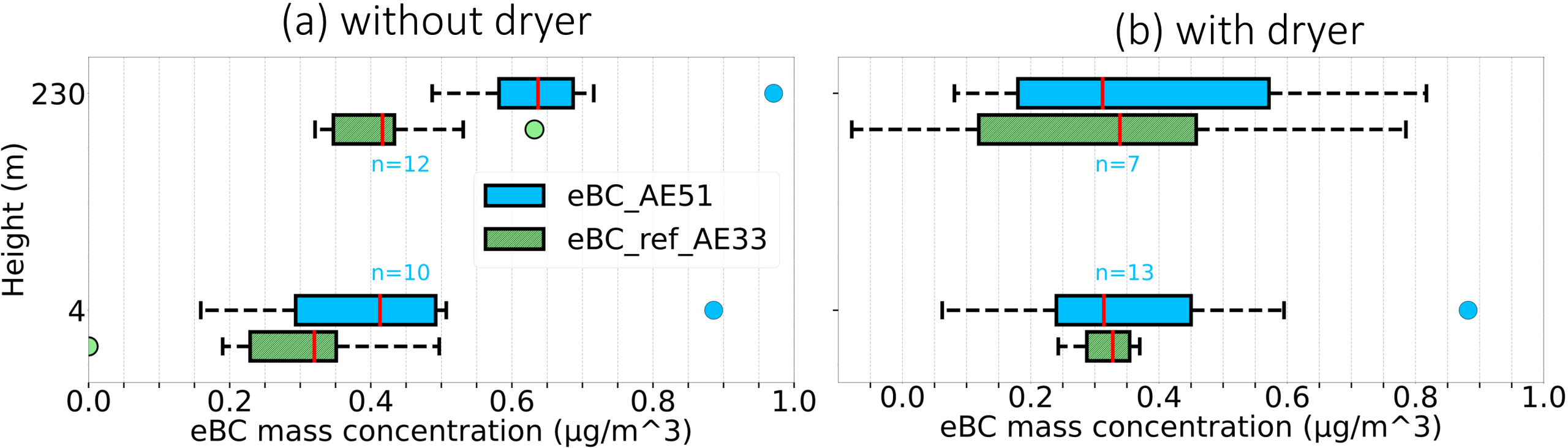
For this reason, the vertical variability of equivalent black carbon (eBC) and aerosol particle number concentration was studied using drone-based measurements. The work included the design and testing of a lightweight drying system suitable for a drone and the calibration of drone-based eBC measurements against reference aethalometers, which significantly reduced the influence of humidity on the resulting concentrations. Flights were conducted in urban and rural environments in the Czech Republic, focusing on seasonal differences and the roles of atmospheric stability, local emissions, and long-range transport.
The results show that at the rural site, both eBC concentrations and particle number concentrations systematically decrease with height, although the magnitude of this decrease varies seasonally. In winter, eBC concentrations are significantly higher due to stable atmospheric stratification and an increased contribution from combustion sources, whereas in summer the vertical gradient is influenced by more intense atmospheric mixing. In the urban environment, the vertical aerosol structure in summer is nearly homogeneous throughout the observed layer, while in winter, concentrations gradually decrease with height. Special attention was paid to high-pollution episodes, during which long-range transport plays a significant role in shaping the vertical aerosol distribution and can locally override the influence of surface-layer sources.
This study was conducted as part of a collaboration between the Research Group of Aerosol Chemistry and Physics, the Global Change Research Institute of the CAS, and the Finnish Meteorological Institute.
- Julaha K., Ždímal V., Mbengue S., Brus D., Zíková N.: Drone-based vertical profiling of particulate matter size distribution and carbonaceous aerosols: urban vs. rural environment. Atmos. Chem. Phys. 2025, 25(23), 17933-17951. doi.org/10.5194/acp-25-17933-2025