Heat and mass transport near solid surfaces have long been studied in the Research Group of Multiphase Reactors, in connection with electrodiffusion measurements, microfluidic devices, and general transport problems in shear flow. In many practical systems, however, the whole surface is not active. Reaction, absorption, or heat transfer may occur only on separated segments, whereas the surrounding parts of the wall remain inactive. This situation arises, for example, in segmented electrodes, microelectrode arrays, surface sensors, microfluidic electrochemical chips, and isothermal strips embedded in an otherwise insulated wall. Transfer to a single active segment is then determined not only by its own size. It is also affected by the depleted wake created by preceding active segments and by the partial recovery of the concentration or temperature field over inert gaps.
This problem is addressed in a paper by authors from the Institute of Chemical Process Fundamentals of the Czech Academy of Sciences, Jan Evangelista Purkyně University in Ústí nad Labem, and Université Gustave Eiffel in France. The authors studied scalar transfer, such as concentration or temperature transfer, from a linear shear flow to an arbitrary finite array of reactive segments embedded in an otherwise inert wall. The main result is a recursive Abel-integral formulation. It allows additional reactive segments to be appended one by one and provides the segment-wise transfer coefficient for each segment directly. The formulation is based on the classical Lévêque approximation, in which transport is governed by convection along the wall and diffusion normal to it. Because streamwise diffusion is neglected in this model, the solution has a natural downstream causality: a segment placed farther downstream cannot influence the field above preceding segments.
The advantage of the new formulation is that it does not require a periodic arrangement of segments or replacement of the heterogeneous surface by a homogenized boundary condition. Finite arrays with arbitrary segment lengths and arbitrary gaps can therefore be treated directly. The recursive solution was checked against direct finite-volume solutions of the same reduced transport equation. The calculations showed that regular arrays of segments can transition between three regimes: behavior close to a continuous reactive strip, a strongly shielded array, and weakly interacting segments. For irregularly spaced arrays, the effect of the total inert-gap length was separated from the effect of the streamwise placement of the gaps. The result provides a compact semi-analytical benchmark for segmented electrodes, microelectrode arrays, reactive coatings, surface sensors, and related heat-transfer configurations.
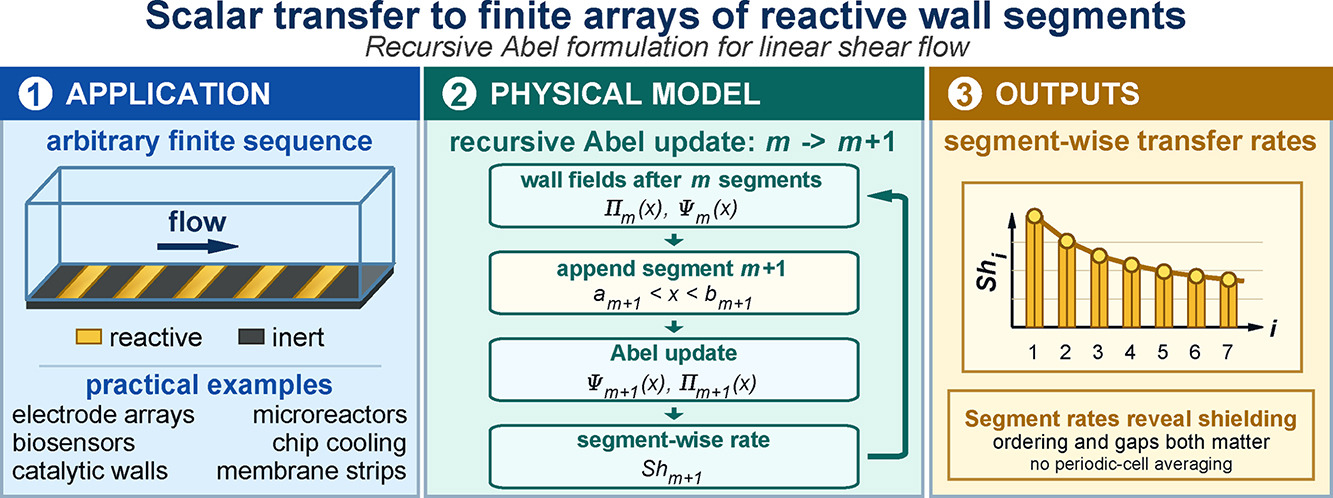
Schematic representation of scalar transfer to an array of reactive segments embedded in an inert wall. Active segments create a depleted wake that affects transfer to downstream segments. Inert gaps allow only partial recovery of the concentration or temperature field.
- Harrandt V., Bazaikin Y., Huchet F., Tihon J., Havlica J.: Scalar transfer to arbitrary finite arrays of reactive wall segments in linear shear flow: A recursive Abel-integral formulation. Int. Commun. Heat Mass Transf. 2026, 179, 112083. doi.org/10.1016/j.icheatmasstransfer.2026.112083.